Why Investing in Healthcare Asset Management Delivers Long-Term Value
.webp)
Investing in healthcare asset management delivers measurable long-term value by reducing equipment downtime, lowering maintenance costs, ensuring regulatory compliance, and extending the useful life of critical medical assets. Hospitals that implement structured asset tracking systems consistently report significant cost savings, improved care delivery, and stronger audit readiness — making it a strategic priority, not just an operational one.
The Real Cost of Unmanaged Medical Assets
Most hospital administrators are acutely aware of capital expenditure pressures. What often goes unexamined is the hidden cost of not managing assets effectively. Equipment that goes missing, sits idle, or fails unexpectedly doesn't just disrupt workflows — it carries a financial penalty that compounds over time.
Consider these realities:
- Hospitals lose an estimated 10–20% of mobile medical equipment annually due to misplacement or theft
- Unplanned equipment downtime can cost a facility thousands of dollars per hour in cancelled procedures
- Over-purchasing replacement equipment — because existing inventory is untraceable — inflates capital budgets unnecessarily
- Reactive maintenance costs up to three times more than planned, preventive servicing
These aren't theoretical risks. They're recurring line items in healthcare budgets that structured asset management directly addresses.
What Healthcare Asset Management Actually Covers
Healthcare asset management is the systematic process of tracking, maintaining, and optimising physical assets across a medical facility — from high-value diagnostic equipment to consumables and infrastructure. It spans the entire asset lifecycle: procurement, deployment, preventive maintenance, compliance certification, and eventual disposal or replacement.
For hospital administrators and facility managers, this means having real-time visibility into:
- Where every piece of equipment is located at any given time
- When it was last serviced and what's due next
- Whether it meets current regulatory and safety standards
- Its depreciation status and remaining useful life
This isn't just about accountability. It's about making better, faster decisions with accurate data rather than assumptions.
How Equipment Lifecycle Tracking Reduces Long-Term Costs
One of the most compelling financial arguments for medical equipment asset management lies in lifecycle tracking. When facilities understand exactly how old equipment is, how heavily it's been used, and what maintenance it has received, procurement decisions become far more strategic.
Planned Replacement vs. Emergency Procurement
Equipment failures that catch facilities off guard typically result in emergency procurement — often at premium cost, with compressed evaluation timelines. Lifecycle data changes this entirely. When asset management systems flag approaching end-of-life for a CT scanner or infusion pump fleet, procurement teams can plan replacements in advance, negotiate better terms, and budget accurately across fiscal years.
Preventive Maintenance as a Revenue Protector
A 2022 study published by the Healthcare Financial Management Association found that facilities with robust preventive maintenance programs reduced equipment-related downtime by up to 45%. In procedural areas — surgical suites, radiology, ICUs — that translates directly into protected revenue streams and uninterrupted patient care.
Preventive maintenance schedules, automatically triggered through asset management platforms, ensure nothing slips through the cracks. Engineers aren't chasing paperwork. Managers aren't relying on memory. The system manages the schedule.
Regulatory Compliance: From Burden to Built-In Process
In healthcare, regulatory compliance isn't optional — and it's increasingly complex. Facilities must meet standards set by bodies such as the Therapeutic Goods Administration (TGA) in Australia, the Joint Commission in the United States, and equivalent authorities across other jurisdictions. Equipment must be regularly inspected, calibrated, and certified, with full documentation trails maintained for audits.
Manual compliance tracking — spreadsheets, paper logs, disconnected systems — is both labour-intensive and error-prone. A missed calibration record or incomplete service log can trigger audit findings, accreditation issues, or in serious cases, patient safety incidents.
Asset Management Systems Make Compliance Automatic
Modern asset management platforms embed compliance requirements directly into asset records. Each piece of equipment carries its own certification schedule, service history, and documentation archive. When an audit occurs, the data is already organised and retrievable — not scrambled together under pressure.
For procurement officers, this also means smarter vendor management. Service contracts, warranty terms, and compliance obligations are all linked to the asset record, providing a single source of truth.
The Strategic Case: Three Areas Where ROI Is Demonstrable
Area | Challenge Without Asset Management | Outcome With Asset Management
|
|---|---|---|
Equipment Utilisation | Idle assets go undetected; over-purchasing occurs | Utilisation data drives smarter procurement and redeployment |
Maintenance Cost Control | Reactive repairs dominate; downtime is unpredictable | Preventive schedules reduce repair costs and unplanned failures |
Regulatory Readiness | Documentation gaps create audit risk | Automated records support continuous compliance |
Utilisation Data: The Overlooked Asset Optimisation Tool
Hospital administrators often focus asset management conversations on maintenance and compliance. But utilisation data may be the most underused lever available.
When asset tracking systems reveal that a fleet of portable ultrasound units is sitting idle 60% of the time in one ward while another ward routinely delays procedures waiting for availability, the solution isn't purchasing more equipment. It's redeployment — informed by data. This single insight, replicated across dozens of equipment categories, can materially reduce capital expenditure year over year.
Facilities that actively monitor utilisation rates also build stronger business cases for capital investment. Rather than requesting budget based on perceived need, procurement officers can present actual usage data, equipment age profiles, and projected failure timelines. That's a fundamentally different — and more credible — conversation to have with hospital boards.
Implementation Considerations for Healthcare Facilities
Deploying an asset management system in a healthcare environment comes with specific operational considerations. Integration with existing clinical workflows, staff adoption, and data migration from legacy systems all require careful planning.
Practically speaking, successful implementations tend to share these characteristics:
- Cross-departmental buy-in: Clinical, maintenance, and finance teams all benefit — but all need to be part of the process from the outset
- Phased rollout: Starting with high-value or high-risk equipment categories allows teams to build confidence before expanding system-wide
- Integration with existing CMMS or ERP platforms: Standalone asset systems create data silos; connected systems create visibility
- Training and change management: Technology adoption fails without it — particularly in clinical environments where staff are already time-pressured
Long-Term Value Is Cumulative
The financial and operational case for healthcare asset management strengthens over time. In year one, the gains are largely about eliminating waste — finding assets that were written off but are still in service, correcting maintenance backlogs, and bringing compliance documentation up to date. By year three, the benefits shift toward strategic: procurement cycles that are genuinely data-driven, maintenance costs that are predictable, and regulatory audits that no longer create institutional anxiety.
This compounding return is why leading healthcare systems — from large public hospital networks to private specialist facilities — are treating asset management not as an IT project, but as a core operational strategy.
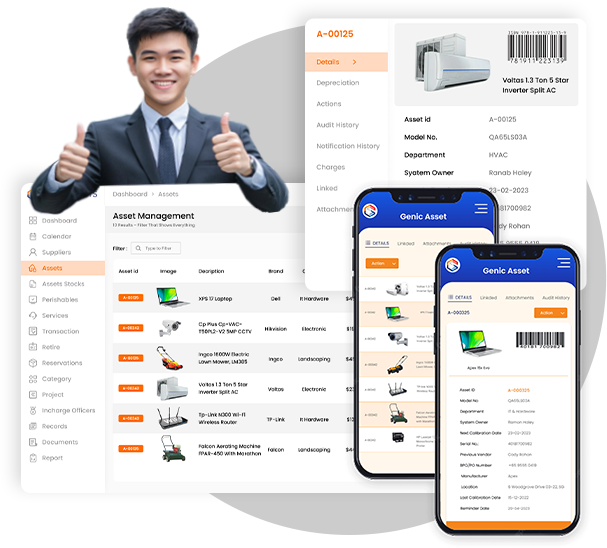
For facilities looking to build this capability with a platform designed specifically for asset-intensive industries, Genic Assets offers healthcare-focused asset management solutions that address the full lifecycle — from procurement through to disposal — with compliance and reporting built in from day one.
Commonly Asked Questions
Why is healthcare asset management important and what does it entail?
The organised process of monitoring, preserving, and optimising physical assets at healthcare institutions, such as infrastructure, surgical instruments, and diagnostic equipment, is known as healthcare asset management. It is important because poorly managed assets result in higher expenses, equipment failure, noncompliance, and bad procurement choices. A well-designed system facilitates improved financial planning and provides facilities with real-time control over their asset base.
How might asset management for medical equipment lower expenses?
By enabling preventive maintenance—which is substantially less expensive than reactive repairs—eliminating needless equipment purchases through utilisation data, and prolonging asset lifecycles through prompt servicing, medical equipment asset management lowers costs. Additionally, facilities minimise the financial consequences of unscheduled downtime in clinical areas that generate income. Savings usually exceed implementation costs by a significant margin over a period of three to five years.
In what ways can asset management help hospitals adhere to regulations?
Every piece of equipment has its full service history, calibration records, and certification paperwork stored on asset management platforms. This establishes an ongoing, audit-ready compliance record that satisfies regulations set forth by organisations like the TGA, Joint Commission, or other national agencies. Automated alerts lower the possibility of non-compliance findings during accreditation reviews by ensuring that certification and service deadlines are never missed.
In a medical facility, what kinds of assets need to be watched over?
Every asset that affects patient care, operational continuity, or regulatory compliance must be watched over. This includes surgical tools, ventilators, infusion pumps, biomedical devices, diagnostic imaging equipment, and facility infrastructure such as sterilisation units and HVAC systems. High-value, mobile, and safety-critical equipment are typically prioritised in phased implementations.
How long does it take a healthcare asset management system to show a return on investment?
After 12 to 18 months of implementation, the majority of healthcare facilities start to see quantifiable ROI. Recovering untracked assets, cutting back on emergency repair expenditures, and getting rid of duplicate purchases are usually the first gains. Over a period of three to five years, strategic ROI—from decreased compliance risk, data-driven capital planning, and optimised equipment lifecycles—becomes increasingly noticeable.
Does asset management work with the hospital's current systems?
Sure. Enterprise Resource Planning (ERP) systems, procurement platforms, and Computerised Maintenance Management Systems (CMMS) are all integrated with contemporary healthcare asset management platforms. Instead of generating more silos, integration guarantees that data flows uniformly across departments. Integration capacity with existing healthcare and financial systems ought to be a primary selection criterion when assessing options.
.jpg)

Comments
Post a Comment